
The Matthew Effect – and Why We Are All Part of the Problem and, at the Same Time, Part of the Solution
Work on this article began long before our 2mal20netto podcast episode #233, “Women’s National Team: Lighthouse or Symbolic Politics?”, but it was ultimately finalised with impulses from that episode. In episode 233, taking the German women’s national futsal team announced for 2027 as our starting point, we explored the question of what adding another highly visible structure at the top actually means for the development of futsal as a whole.
This article, however, deliberately moves beyond that specific debate. It is not about the pros and cons of the German women’s national team, but about a more fundamental question:
How is futsal developing nationally and internationally – and how do we actually know whether a sport is developing?
Because futsal is growing. At least, that is what it looks like. National teams are becoming more professional, international competitions are expanding, the UEFA Futsal Champions League produces spectacular images, and national associations are creating performance centres, youth national teams and coaching licences. UEFA now speaks of around 30 million people playing futsal worldwide. While only 17 associations took part in the European national-team competition in 1996, 48 entered the UEFA Futsal EURO 2026. The qualifying competition alone comprised 146 matches and attracted more than 160,000 spectators.
So the lighthouses of futsal are shining. And they are becoming brighter and brighter.
As the Futsal Philosopher, however, I am interested in another question:
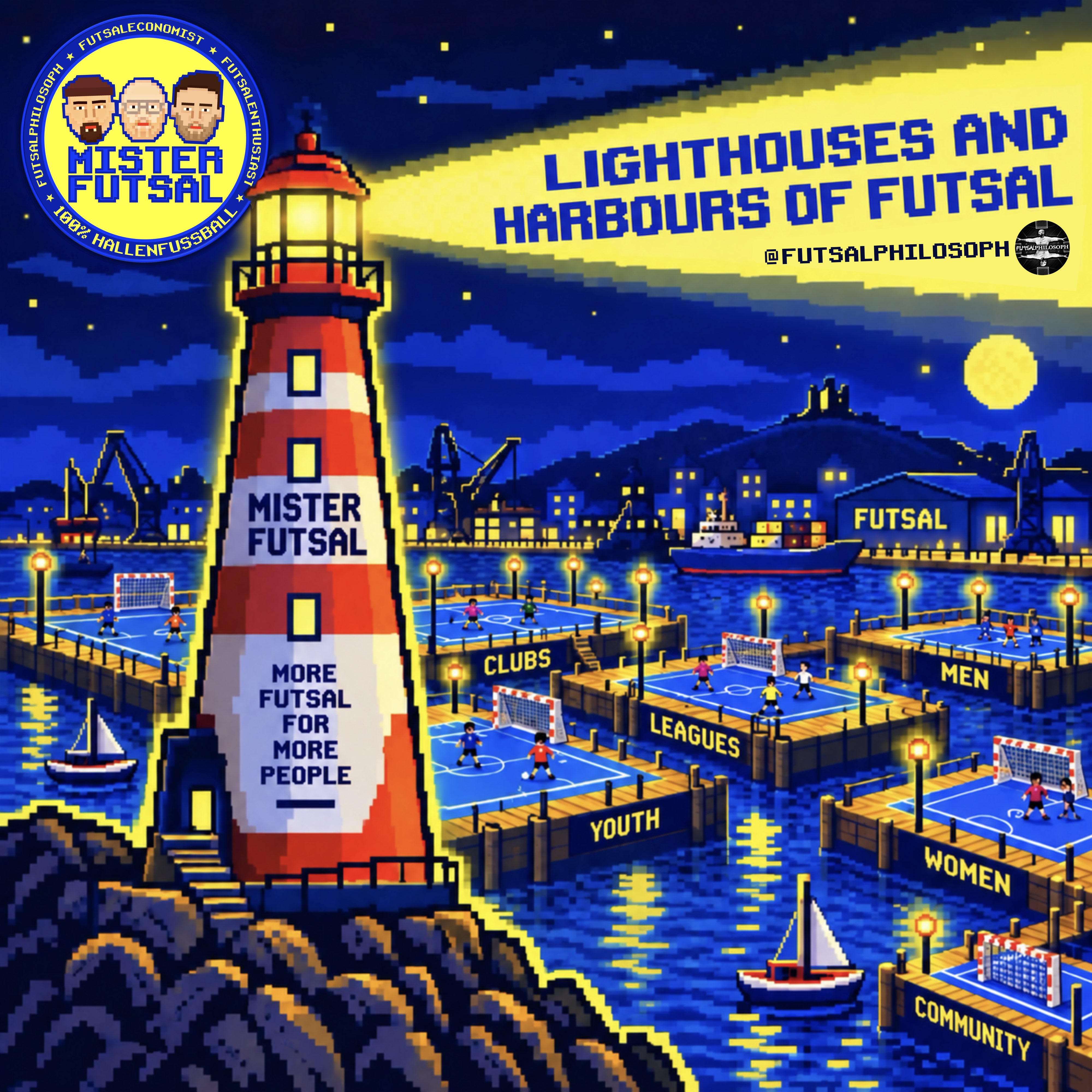
What is happening to the harbours of futsal?
Because a sport does not develop only where national-team players take to the court, Champions League matches are played and trophies are lifted. Above all, it lives where twelve people unlock a sports hall on a Wednesday evening; where somebody volunteers to coach a team; where a young person touches a futsal ball for the first time; where a club registers a new team; where a regional league functions; and where the next opponent remains within reasonable travelling distance.
A sport lives where people can not only watch it, but play it.
And this is where the story becomes more complicated.
“For whoever has will be given more.”
In 1968, the American sociologist Robert K. Merton transferred a phrase from the Gospel of Matthew to the world of science and called it the Matthew Effect: “For whoever has will be given more.” According to Merton, already renowned scientists receive disproportionately high levels of attention and recognition for their achievements. That recognition, in turn, increases their visibility and improves their chances of acquiring further resources and achieving further success.
Advantage produces further advantage.
Merton developed this into the concept of cumulative advantage. An initial advantage can develop into an upward spiral; an initial disadvantage into a downward one.
Perhaps this can also describe one of futsal’s central developmental problems. Those who already have national-team players and elite clubs find it easier to continue investing in those structures. International competition generates visibility; visibility increases attractiveness to sponsors; additional resources improve the conditions for further success.
Success produces the conditions for further success.
Meanwhile, the club two levels below needs something far more mundane: a sports hall on a Wednesday evening.
The Matthew Principle of Futsal
My central thesis is therefore:
Futsal does not suffer only because too little is invested in it. What also matters is where within futsal that investment goes.
Resources often follow visibility, status and existing success.
At the top, this can create a cycle:
performance → attention → resources → better conditions → higher performance.
Further down, the same mechanism can operate in reverse:
few teams → little visibility → low priority → fewer resources → poorer conditions → even fewer teams.
Eventually, we are confronted with a strange picture:
The lighthouses grow brighter and brighter while the harbours fade away.
It is the logic of the Matthew Principle:
Those who already have are more likely to receive even more; those who have little risk losing even what little they have.
Germany: Better and Worse at the Same Time
Germany provides an interesting example. The German national futsal team played its first official match in 2016, followed by the launch of the Bundesliga in 2021. The elite level became more professional, the national team more competitive, and the Bundesliga established a nationwide top tier.
At the same time, our Mister Futsal development reports reveal a different trajectory at grassroots level. According to our corrected dataset, organised German futsal reached approximately 180 teams in 151 clubs in 2020. By 2024, that figure had fallen to 107 teams in 84 clubs. In 2026, there was a first modest recovery, with 115 teams in 95 clubs.
From the statistical peak to the low point, around 40 per cent of teams disappeared. Of course, the national team and Bundesliga did not cause this decline. The pandemic, access to sports halls, regional association structures, volunteer resources and numerous other factors all played a role.
But neither is there evidence in these figures of an automatic trickle-down effect resulting from professionalisation at the top.
German futsal was able to become better at the top while becoming structurally smaller.
Or, put differently:
Elite-sport development is not automatically the same as sport development.
The Netherlands and England: Two Warning Signs
Internationally, similar examples can be found. The Netherlands has a considerably older futsal tradition than Germany. Nevertheless, the KNVB was forced to reorganise its futsal pyramid. Several teams had withdrawn from the Eredivisie and Eerste Divisie, vacant places were filled by lower-ranked clubs, and performance gaps increased.
The KNVB is therefore reducing the size of the Eredivisie and reforming the levels below it – explicitly with the aim of recreating a foundation for future growth.
This shows:
An established elite does not guarantee a stable pyramid underneath it.
England offers a different case. In 2020, under the financial pressure of the COVID-19 pandemic, the Football Association withdrew funding from its elite futsal national teams while also significantly reducing grassroots support. The FA explained that it needed to protect its “core functions” and “key priorities”, including the England men’s and women’s football teams.
At the same time, it continued to describe futsal as a means of developing football players and their footballing abilities.
Empirically, we can initially say only this:
When resources became scarce, football was prioritised over futsal, while futsal was simultaneously reduced in functional terms to its usefulness for football.
But that leads to an interesting question:
What does a football association actually see when it looks at futsal?
The Lighthouse Builders and Their Habitus
National associations are not neutral machines. Decisions within them are made by people with biographies, socialisation experiences and sporting careers.
In Pierre Bourdieu’s terminology, they possess a habitus.
Put simply, habitus describes relatively durable schemes of perception, evaluation and action. It influences what we perceive, how we evaluate it and which actions appear self-evident to us.
This does not mean that the English decision allows us empirically to demonstrate a particular habitus among individual officials. We cannot look inside their minds. But as a theoretical interpretation, we can ask whether it reveals a football-centred institutional habitus, through which futsal is viewed not primarily according to its own internal logic, but through the perceptual categories of dominant football.
A football official may primarily see indoor sport, five-a-side, technical training and talent development for football.
A futsal official, by contrast, may see an independent sport with its own culture, tactics, training science, coaches, athletes and history.
Both are looking at the same game.
But they are not seeing the same reality.
The Lighthouse Keepers and Their Voluntary Servitude
Perhaps there are therefore not only lighthouse builders, but also lighthouse keepers: people who decide where resources are deployed, which competitions matter, which indicators constitute success and which problems make it onto the agenda in the first place.
Their habitus may influence not only how much light falls where, but already which coastlines they perceive and what they recognise as a harbour worth preserving.
As early as the sixteenth century, Étienne de La Boétie asked in his Discourse on Voluntary Servitude how domination could remain stable even though those being ruled vastly outnumbered those ruling them. One of his answers lies in habit: people can become accustomed to existing orders, perpetuate them and eventually experience them as self-evident.
Of course, it would be absurd to equate political tyranny with a modern sports association. La Boétie serves here exclusively as a philosophical lens through which to think about habituation and the voluntary reproduction of existing orders.
And that raises an uncomfortable question:
What if the system persists not only because lighthouse keepers organise it this way, but because all of us have learned to think about futsal development in precisely these terms?
National team = progress.
Bundesliga = progress.
More international matches = progress.
A better FIFA ranking = progress.
Until, eventually, we forget to ask the most important question:
Has this actually created more futsal?
Clubs celebrate national-team call-ups, associations celebrate international results, players move to where the greatest resources already exist, and media preferentially cover the Bundesliga and national team. Every individual decision is understandable. Taken together, however, they can reproduce precisely the order that we subsequently criticise.
Or, to return to our metaphor:
Perhaps the lighthouse keepers decide where the light falls – but every day, all of us carry a little more oil upstairs to keep it burning.
Understanding Futsal Development Through Merton, Bourdieu and La Boétie
The theoretical argument of this article can therefore be condensed into three ideas:
Merton explains accumulation. Bourdieu explains perception and evaluation. La Boétie explains habituation and reproduction.
The Matthew Principle explains why existing advantages can produce further advantages. Habitus helps us understand why certain forms of success appear particularly valuable. And La Boétie directs our attention towards why an established order may also be sustained by people who benefit from it only partially.
Bourdieu offers two further useful concepts here. Distinction points to the way social fields differentiate and establish hierarchies: a national team, the Champions League or Bundesliga carries more institutional prestige than a new regional league, a youth team or a volunteer coach.
The lighthouse possesses symbolic capital; the harbour possesses everyday life.
The concept of illusio can also help explain why this hierarchy may appear rational within the system of football associations. Who qualifies for the EURO? Who improves their ranking? Who meets international standards? One additional regional team does not alter a UEFA ranking. Winning an international match does.
This produces a structural problem:
The people who decide on the development of the grassroots are often institutionally judged by the development of the elite.
But Does Our Thesis Actually Hold Internationally?
A good thesis has to withstand counterexamples. If our thesis were that futsal is not growing internationally, it would simply be wrong. UEFA documents significant international expansion – and some countries demonstrate that lighthouses and harbours can grow at the same time.
Portugal reported 43,704 registered futsal players at the beginning of 2025, 8.8 per cent more than a year earlier. Growth is therefore taking place in a country that simultaneously possesses one of the brightest futsal lighthouses in the world.
Even more interesting is France. In 2023, the Fédération Française de Football reported more than 38,000 registered futsal players, representing 14 per cent growth, as well as 1,582 clubs or sections. At the same time, the FFF allocated a total of €18.4 million to its 2022–2025 development plan – not merely for elite sport, but also for education, regional expansion, competitions, youth development, schools, women’s futsal, club development and infrastructure.
France therefore provides perhaps the most important counterexample:
It is not merely making the lighthouse brighter. It is building harbours at the same time.
Portugal and France therefore contradict a simplistic narrative of decline, but they do not contradict our metaphor.
On the contrary, they sharpen it:
Bright lighthouses do not cause harbours to disappear. The problem begins when lighthouse-building and harbour-building become disconnected from one another.
The decisive question therefore becomes:
What grows alongside the elite?
Spain: Perhaps We Have Reversed the Causality
Spain also helps us change perspective. The country has world-class players, elite clubs and an internationally successful national team. Yet beneath these lighthouses lies a broad futsal culture that has existed for decades, with regional competitions and age-group structures.
According to RFEF data, Catalonia alone had 31,906 registered futsal players in the 2023/24 season, Andalusia 17,350 and Galicia 15,508.
Perhaps, then, we often tell the causal story the wrong way around.
Not only:
Futsal thrives in Spain because Spain has a successful national team.
But perhaps, more fundamentally:
Because Spain has a broad futsal culture, it is able to produce successful national teams and elite clubs on a lasting basis.
The elite, then, does not primarily produce the grassroots.
The grassroots reproduce the elite.
The Matthew Principle Between and Within Countries
Portugal, Spain and, increasingly, France already possess extensive structures of players, coaches, clubs, competitions and infrastructure. Additional investment there enters a comparatively functioning system.
In a structurally less developed futsal system such as Germany’s, the same additional euro often encounters much thinner club, competition, youth and infrastructure structures.
The Matthew Principle also operates within countries. Strong regions attract players; strong clubs attract talent. National-team players move to elite clubs, which can then become even stronger. Weaker clubs lose quality and potentially attractiveness as well.
A system can therefore become very good at concentrating existing quality without producing new quality to the same extent.
Concentrating existing quality is not the same as producing new quality.
A thought from sociologist Aladin El-Mafaalani is useful here: opportunities can improve for everyone without inequality becoming smaller. If, for example, everyone’s income doubles, everybody has more – but the absolute gap also grows.
Perhaps something similar is happening internationally. Futsal is growing overall: more national teams, competitions, spectators and media visibility. Yet inequalities within that growth may still increase.
The interesting question is therefore no longer:
Is futsal growing?
But:
Where is futsal growing – and who benefits from that growth?
From Trickle-Down to the Matthew Effect
Elite sport often contains an implicit hope of trickle-down: we invest at the top, success generates visibility and enthusiasm, and eventually development filters downwards.
But under certain conditions, resources may instead accumulate at the top. A successful club needs more money for international competitions; a more competitive national team needs more training camps; a professionalised league requires additional resources to develop its standards further.
Every developmental step at the top creates demand for the next one.
The brighter the lighthouse becomes, the more energy the lighthouse requires.
That is why every major futsal decision should be accompanied by two questions:
What does this decision improve at the top – and what does it produce at the grassroots?
With a national team, we should therefore ask not only how competitive it is, but whether new players and opportunities emerge around it. With a Bundesliga, we should ask whether regional structures and clubs grow alongside it. With a coaching licence, we should ask how many people subsequently become better able to teach futsal in practice.
That would represent a different logic of sports development.
We Do Not Need Weaker Lighthouses
The solution is explicitly not fewer national teams, less Bundesliga or less professionalisation.
We need strong lighthouses. Elite sport can create identification, quality, knowledge, inspiration and visibility.
But:
We must stop confusing lighthouse-building with harbour-building.
Portugal shows that both can grow. France is attempting systematically to connect elite development with structural development. Spain demonstrates the importance of an established futsal culture. The Netherlands shows that even tradition does not automatically protect the levels beneath the elite. And England demonstrates what can happen when futsal occupies a lower position than football within an institution’s system of priorities.
The question, therefore, is not:
Lighthouse or harbour?
But:
How do we build both together?
Perhaps We Need a Different Way of Seeing
The analysis therefore does not end with money, but with perception.
Before resources are distributed, reality is evaluated. Before decisions are made, reality is perceived. And before something can count as a problem, it first has to be seen as a problem.
Perhaps decision-makers therefore need to understand futsal more strongly as a social ecosystem: from the teenager to the national-team player, from the volunteer coach to the national coach, from regional leagues to the Bundesliga and Champions League.
But La Boétie simultaneously forces us not to point only at associations.
Clubs, coaches, players, media and fans also reproduce ideas about what matters in futsal.
And that includes us at Mister Futsal.
Mister Futsal Between Harbours and Lighthouses
At Mister Futsal, we do not see ourselves as neutral observers, but as a living part of German futsal culture. Through our work, we too make decisions about what receives attention and thereby becomes visible and significant.
That is precisely why even the structure of our weekly 2mal20netto podcast is a deliberate choice. The first – and therefore most important – topic of every episode is feedback from our community. Only then do international and national news follow, along with our deeper sporting, social, scientific, political, economic or philosophical discussions.
After that, we turn to German competition – deliberately from the bottom upwards. We begin with the association and regional leagues and work our way through the futsal pyramid.
The Bundesliga comes last.
Not because it is unimportant, but because we refuse to equate importance automatically with hierarchy.
If attention creates symbolic capital, then the order in which we distribute our attention is itself a decision.
And we do not merely want to talk about the harbours. We want to be there. That is why we do more than produce the podcast and publish articles such as this one: we livestream the Regionalliga in Wuppertal, broadcast pre-season tournaments such as the Seleção Cup, and also report from the Bundesliga in Cologne.
Our logic is not:
Grassroots instead of elite.
It is:
Grassroots and elite. Harbours and lighthouses.
The crucial difference is that we do not want to find a harbour interesting only once a lighthouse happens to shine its beam upon it.
The grassroots do not deserve attention because they might one day produce elite sport. They deserve attention because they are futsal.
And there is more. If we look at developments in Spain, Portugal and, increasingly, France, there is much to suggest that the grassroots should not be treated as a subordinate part of sports development, but should instead be given priority. Not because the elite is unimportant, but because a broad and functioning grassroots base creates the social, sporting and cultural conditions that allow futsal to remain genuinely alive over time.
Spain demonstrates particularly clearly how a futsal culture developed over decades can continually generate new players, coaches, clubs and ultimately elite sport. Portugal shows that an internationally outstanding elite can coexist with a growing number of futsal players. France, meanwhile, is attempting systematically to connect the expansion of its elite with club development, youth development, education, regional expansion and infrastructure.
Perhaps, then, we need to make an even more fundamental distinction between a sport’s survival and its being alive.
A sport can survive institutionally as long as it has a national team, a top division, a handful of competitive clubs and an association maintaining the necessary competition structures. On paper, it exists. It has results, league tables, national-team players and perhaps even international success.
But a sport is truly alive only when it can continually reproduce itself: when new people begin to play it; when teams are created rather than merely disappearing; when coaches are trained and actually find teams to coach; when children and young people have access to the game; when regional competitions have enough participants; and when clubs are not permanently fighting for court time and their bare existence.
That is the crucial distinction between existence and vitality.
And perhaps this distinction describes the state of futsal in many countries more accurately than any FIFA ranking:
In many places, futsal has too much to die – and too little to live.
Too much to disappear entirely: national teams, committed clubs, officials, coaches, players, competitions, history, knowledge and passion. Yet at the same time, too little breadth, infrastructure, youth development, regional density and everyday normality to reproduce itself sustainably from within.
At that point, a sport is no longer primarily fighting for development. It is repeatedly fighting for its own reproduction. Its energy flows not primarily into growth, but into maintaining what already exists. Teams are not founded to expand a pyramid; teams are searched for so that a league can take place at all. Coaches are not needed because ever more teams are emerging; instead, the same small group of committed people keeps several structures alive at once.
Every lost court slot, club or volunteer becomes existential because the grassroots have become too thin.
That is precisely why the harbours deserve priority rather than the lighthouses:
So that there remains a coastline on which lighthouses can have a lasting purpose at all.
A lighthouse can be visible from far away. It can become brighter, taller and technically ever more sophisticated. But without harbours, without ships and without people actually using that coastline, its light eventually becomes a paradoxical symbol:
A bright lighthouse proves that there is light at the top. But it tells us nothing about how much life exists along its coast.
If we criticise the way attention and symbolic capital repeatedly move upwards, then as a futsal medium we must not reproduce that same logic ourselves. Our task is not merely to observe, comment on and criticise futsal culture, but to help create a small part of the culture we would like to see.
We do not merely want to measure how brightly the lighthouses shine. We want to help ensure that the harbours remain visible – and that new ones emerge.
Conclusion: The Light Is Not the Problem
The problem is not that the lighthouses are becoming brighter. They should.
It becomes problematic when we confuse their brightness with the health of the entire coastline. A national team can become more successful while clubs disappear. A Bundesliga can develop more professional elite teams while its structural base shrinks. A sport can become more visible internationally without becoming easier for an individual person to access.
That is why we should not merely measure the light.
We should begin counting the harbours, making them visible, investing in them and building new ones.
The Matthew Principle is not a law of nature in futsal. It describes a mechanism through which existing advantages can generate further advantages. And precisely for that reason, we can also counteract that mechanism.
Perhaps the journey of this article can therefore be concluded as follows:
The future of futsal will not be decided solely in the offices of associations, nor solely on the courts of its national teams. It will be decided by the understanding of development that all of us reproduce every day.
Because ultimately, the future of futsal will not be determined by how brightly its elite shines,
but by how many people along its coastline can still find a harbour in which to dock.
 Mister Futsal