
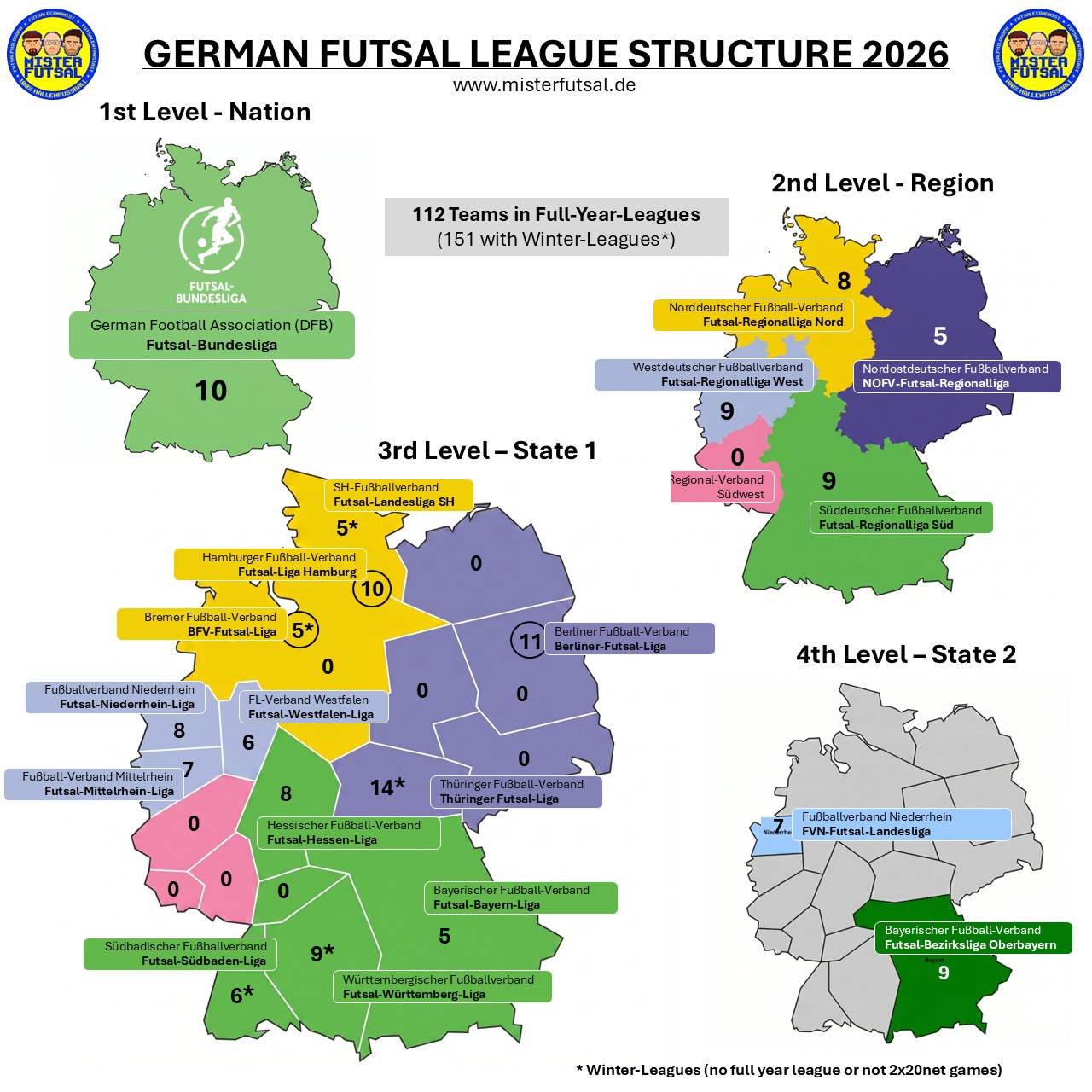
Futsal in Germany has experienced rapid development over the past decade. From the early days of the official German Futsal Championship (which was held as a final tournament from 2006 to 2021) to the founding of the German national futsal team in 2016, right up to the current Futsal-Bundesliga. But what exactly does the foundation look like in 2026?
Our latest „Mister Futsal“ graphic on the 2026 league structure shows a clear picture: Futsal in Germany is growing and becoming more structured, but still struggles with regional disparities. Currently, we count a total of 112 teams in full-year leagues nationwide—if we include the winter leagues, we even reach 151 teams.
Let’s take a detailed look at the pyramid:
1st Level – Nation: The Futsal-Bundesliga
At the top of the pyramid is the Futsal-Bundesliga, organized by the German Football Association (DFB). Since its introduction for the 2021/22 season, it has elevated futsal in this country to a new, more professional level. In the current 2025/26 season, 10 teams are fighting for the crown of German futsal and qualification for the UEFA Futsal Champions League. The Bundesliga is the flagship and the ultimate goal for all ambitious players who might even want to make the leap to the national team.
2nd Level – Region: The Futsal-Regionalligen
Directly below the Bundesliga, league operations are divided among the five major regional associations. This is where exciting developments, but also blank spots on the map, become apparent:
- Western German Football Association (West): Traditionally strongly positioned with 9 teams.
- Southern German Football Association (Süd): Likewise, 9 teams form a strong regional basis here.
- Northern German Football Association (Nord): Has 8 teams in the Regionalliga.
- Northeastern German Football Association (NOFV): Here, 5 teams play in the highest regional division.
- Regional Association Southwest: The major downside. In the southwest, there are currently 0 teams at the Regionalliga level. This is where the greatest development potential lies in the coming years.
3rd Level – State 1: The Futsal-Landesligen
At the state association level, it becomes clear where futsal truly lives at the grassroots. Some associations have established excellent, year-round league operations:
- The Pioneers: The Berlin Football Association leads the way with 11 teams in the Berliner-Futsal-Liga. Closely followed by the Hamburg Football Association with 10 teams. Hesse (8), Niederrhein (8), Mittelrhein (7), and Westphalia (6) also have solid structures. Including 4. Level division, Niederrhein (15) and Bavaria (14) are leading.
- The Winter Leagues (*): Some associations (still) rely on winter leagues. This means there is no year-round operation or matches are not played according to the strict 2×20-minute net time rules. Thuringia stands out here with 14 teams. Schleswig-Holstein (5), Bremen (5), Südbaden (6), and Württemberg (9) also fall into this category.
- Here, too, there are still associations with 0 teams in organized league play (e.g., in large parts of the East and Southwest at the state level).
4th Level – State 2: The Local Grassroots
The true proof of a healthy sport is a deep substructure where matches are also played at the district or county level. So far, only a few associations have reached a functioning 4th level:
- Niederrhein: Below the Landesliga, there is an FVN-Futsal-Landesliga (operating as a 4th league tier) with 7 teams.
- Bavaria: Below the Bayernliga (5 teams), the Bavarian Football Association has established the Futsal-Bezirksliga Oberbayern with 9 teams.
Conclusion: Where does Germany stand in 2026?
The structure for the current 2025/26 season shows: German futsal has a strong top tier and a solid foundation in metropolitan regions like Berlin, Hamburg, and the Ruhr/Rhineland area. The step from the historical, pure final tournament championship to a genuine league system was absolutely the right move.
The challenge for the DFB and the state associations in the coming years will be to breathe life into the blank spots on the map (especially in the southwest) and to gradually transition the winter leagues into more professional, year-round operations.
Feel free to share your thoughts on the current structure in the comments on http://www.misterfutsal.de.


[…] zur Folge:German League Structure: https://misterfutsal.de/2026/04/19/the-german-futsal-league-structure-2026-a-detailed-overview/Interview Marcel Loosveld: […]